
Kenedy Sheriff Release Role
The Kenedy County Sheriff’s official page is the authoritative starting point for a Kenedy arrest. It directly refers custody searches to the Kleberg County Sheriff’s roster. That referral reflects the county’s cross-county holding path. It does not establish that the Sarita office operates a full-service jail, nor does it prove every person arrested at every date went to the same bed.
Ask the Sheriff which agency received the person on the arrest date. Request the basic arrest fields, delivery destination, and any Kenedy-held transfer or release record. The receiving custodian then supplies the jail booking and book-out event. Medical transport, juvenile placement, emergency beds, and later state or federal transfers may create exceptions, so identify the actual custodian before interpreting any roster.
Confirm Kenedy Sheriff Releases
A short verification sequence prevents the most common error: treating the end of one agency’s booking as freedom from all custody.
- Call the Kenedy Sheriff with the full name, date of birth, arrest date, and case or booking number if known.
- Ask where the person was delivered and which office owns the booking and release data.
- Search the named custodian’s current and recent roster, recording exact identifiers and timestamps.
- Request the release type, plain-language code, releasing authority, and destination if transferred.
- Obtain the Kenedy court docket or signed order to confirm the judicial reason.
The Kenedy County released-inmate search covers the state, federal, immigration, and supervision branches when the local jail path does not resolve the person’s status. Keep “not found,” “not currently held,” “released,” “discharged,” and “transferred” separate because the agencies use them for different events.
Kenedy Sheriff Records Contact
The Sheriff’s page lists no dedicated public-information form, submission email, or fixed local fee schedule. Call first to identify the current records contact and accepted delivery method.
Kenedy County Sheriff’s Office
175 Cuellar Avenue
PO Box 10
Sarita, TX 78385
Phone: 361-294-5205
Main fax: 361-294-5260
Administrative fax: 361-294-5209
Administrative hours: Monday through Friday, 8 a.m. to 4 p.m.
Describe the record narrowly. Ask for the arrest report’s basic fields, the receiving facility, transfer documentation, and any Kenedy-held release event. If Kleberg held the person, send the booking and release portion to Kleberg rather than expecting the originating Sheriff to reproduce another county’s jail database.
Kenedy Sheriff Custody Referral
The official Sheriff contact page documents both the Sarita office and its route to the outside custody roster.
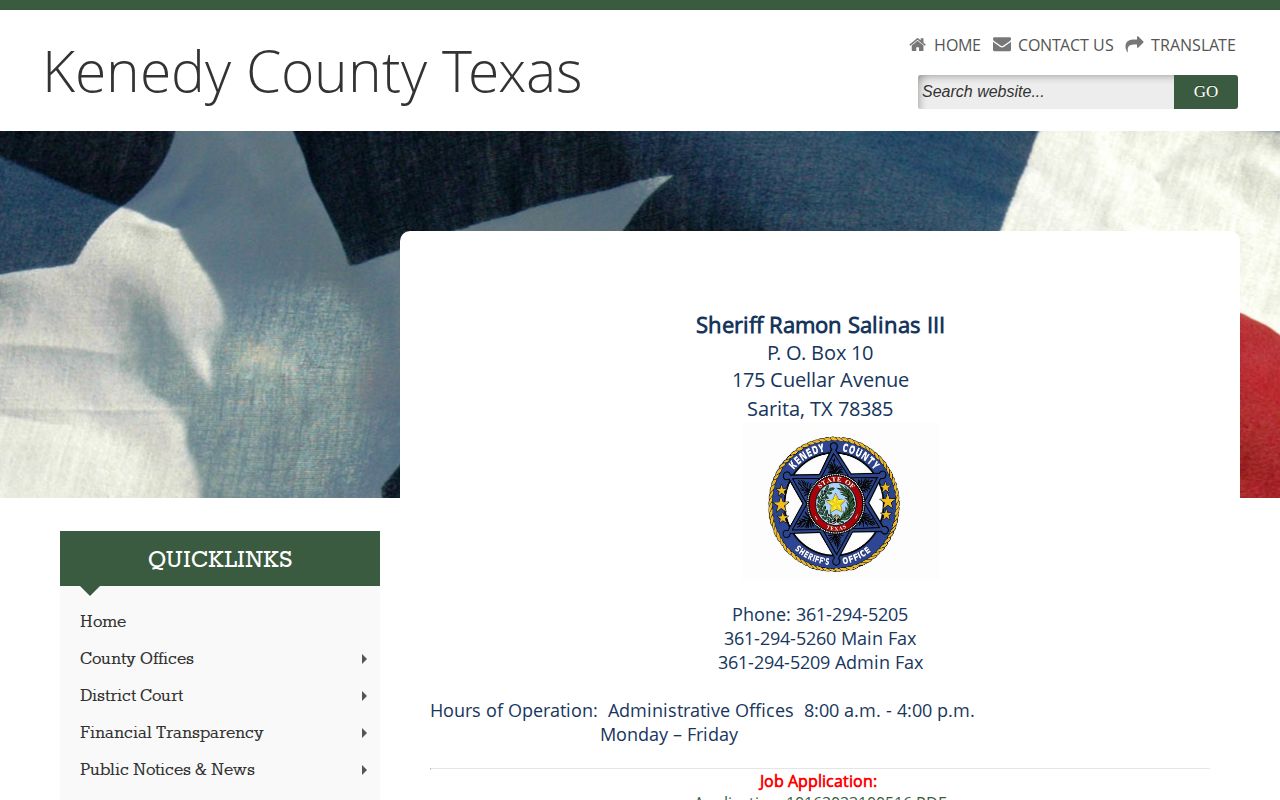
The captured page supports using Kenedy as the first routing call. The actual release timestamp may still belong to the holding agency identified through that referral.
Request Kenedy Sheriff Release Records
Under the Texas Public Information Act, request existing records and fields rather than asking the office to answer a broad question about whether someone is “out.” Provide the full name and aliases, date of birth, approximate arrest date, arresting deputy or agency if known, and cause number. Ask for the delivery destination, date and time, receiving agency, and any release or later transfer fields held by Kenedy.
Government Code section 552.021 supplies the general right of access to government information. Section 552.221 calls for prompt production within a reasonable time. Ten business days is not a universal delivery promise. That period often concerns the deadline for an agency to seek an Attorney General withholding decision under section 552.301.
No fixed local copy fee was found. Request electronic records and a written estimate before costs are incurred. Section 552.108 may protect specified law-enforcement material, while subsection (c) preserves basic information about an arrested person, arrest, or crime from that exception. Other confidentiality rules can still require redaction.
Where Kenedy Sheriff Detainees Go
A person routed into Kleberg custody may later leave on bond, after dismissal, with time-served credit, or under another court authority. A convicted felony prisoner can instead transfer to the Texas Department of Criminal Justice. A detainer may lead to another county, ICE, or federal custody. None of those transfers is a community release.
| Recorded event | Next verification point |
|---|---|
| Community book-out | Holding agency timestamp plus Kenedy court authority |
| Transfer to TDCJ | TDCJ current-inmate record, then TDCJ release history |
| Other county transfer | Receiving county’s booking and later release event |
| Federal or ICE hold | Receiving paperwork, BOP or ICE system as applicable |
| Unknown destination | Kenedy routing record and direct custodian calls |
A court order may authorize release before staff complete the physical book-out. Pair the order with the jail event. When a booking says transfer, add the receiving custodian’s record before describing the person’s status.
Kenedy County, Not Kenedy City
The place name creates a second trap beyond the cross-county jail route. No TDCJ prison unit was found in Kenedy County. The John B. Connally Unit uses Kenedy as its postal city, but the unit is in Karnes County. It must not be added to a Kenedy County facility list or treated as the destination for a Kenedy arrest without an actual transfer record.
Search the facility shown in the person’s record. For a state prisoner, the statewide TDCJ system supplies the current unit, sentence fields, and projected dates. TDCJ Classification and Records or Parole Division confirms a later state release. The Kleberg roster remains a county-jail source and cannot prove release from a Texas prison.
Kenedy Three-Record Release Chain
Kenedy’s clearest local method uses three agencies. The Kenedy Sheriff identifies the originating arrest and receiving custodian. Kleberg supplies the booking, exact book-out time, release code, and transfer destination when it held the person. The Kenedy County and District Clerk supplies the court disposition.
This chain matters because each source has limits. The Sheriff’s referral does not prove where every detainee went. A roster timestamp proves a Kleberg booking ended but may reflect transfer. A bond or dismissal order supplies legal authority but may precede the person’s exit. Read together, the records show who arrested the person, who held them, how that custody ended, and what the court did.
For the clerk record, call 361-294-5220 with the cause number and date range. District matters and county-level matters may use different Sarita street addresses, so ask the combined clerk’s office to route the request correctly.
Older Kenedy Sheriff Release Proof
Web visibility is not record retention. Texas State Library Local Schedule PS lists the county jail register, PS4200-06, as permanent. It includes core fields such as name, intake number, confinement reason, and release or transfer date. Prisoner booking, transport, and release-order records under PS4200-10 have a release or transfer plus two-year minimum. A legal hold, audit, or pending request can extend retention.
Kenedy may not own the jail register if another county operated the booking. Ask Kenedy for the delivery record and ask the custodian for its jail-register entry. An older TCJS report showing Kenedy inmates housed elsewhere can support the broad county practice, but it cannot identify one person’s destination or prove the current arrangement on a specific date.
Read Kenedy Release Terms Exactly
The wording in the response matters. “Bonded out” means conditional pretrial liberty and does not end the case. A personal bond differs from a commercial surety bond. “Time served” usually reflects sentence completion or credit under an order. A dismissal describes the case result, but the holding agency’s timestamp still shows when physical custody ended.
State-law parole and mandatory supervision are forms of supervised release from TDCJ. Discharge can mean the sentence and supervision have ended. By contrast, a transfer to TDCJ, another county, the U.S. Marshals Service, or ICE closes one custodian’s event while confinement continues. Ask the records office to preserve its exact code and supply a plain-language definition instead of substituting a guess.
Public Record Search
Sponsored Results